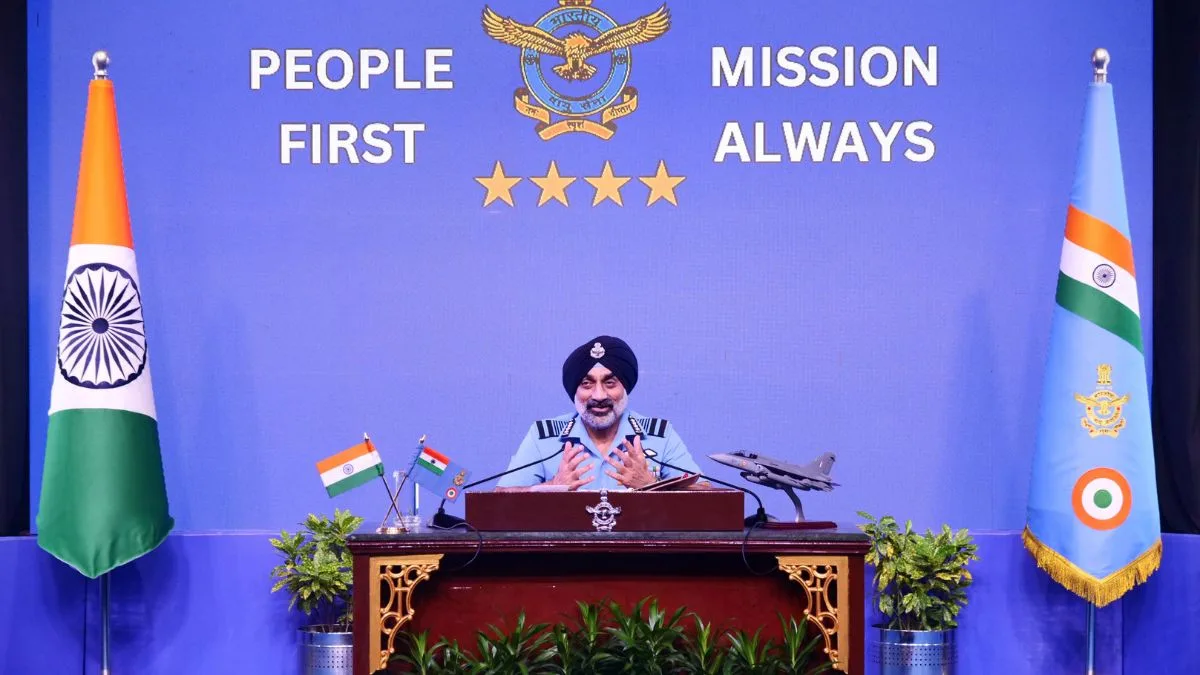
Air Chief Marshal Amar Preet Singh tore into Islamabad with a blunt reminder of India’s military might, declaring that during Operation Sindoor, the enemy was “brought to their knees in just one night.” He asserted that the strike left Pakistan so battered that it was forced to seek a ceasefire after suffering extensive damage.
Addressing the annual press conference held here on Friday, the Air Chief said that the Indian Air Force struck a large number of Pakistan’s airfields and installations in the strikes carried out during Op Sindoor.
Advertisement
Outlining the damage inflicted on Pakistan, the IAF chief said, “As far as Pakistan’s losses are concerned, we have struck a large number of their airfields and we struck a large number of installations. Because of these strikes, radars at least four places, command and control centres at two places, runways of course damaged at two places, then three of their hangars in three different stations have been damaged. We have signs of one C-130 class of aircraft…and at least 4 to 5 fighter aircraft, most likely F-16, because that place happened to be F-16 with whatever was under maintenance at that time.”
“Along with that, one SAM system has been destroyed. We have clear evidence of one long-range strike, which I talked about more than 300 km, which happened to be either an AWACS (Airborne Warning and Control System) or a SIGINT aircraft, along with those five high-tech fighters between F-16 and JF-17 class. This is what our system tells us,” Singh added.
Speaking about the ceasefire that was announced on May 10 following four days of cross-border action, the ACM said, “A clear directive, clear mandate was given to the Indian Armed Forces. It stands as a lesson which will go down in history that this is one war that was started with a very clear objective, and it was terminated in a quick time without just prolonging it.”
“We are seeing what is happening in the world, the two wars that are going on, there’s no talk about termination. But we could make them reach a stage where they ask for a ceasefire, ask for termination of hostilities. And also, we took a call as a nation to terminate those hostilities because our own objectives are met. I think this is something that the world needs to learn from us,” he added.
Hailing the success of long-range missiles and indigenous weapon systems deployed during Operation Sindoor, the Air Chief declared that India’s arsenal rendered Pakistan’s weaponry ineffective even within its own territory. “Our long-range SAMs that we had procured recently and operationalised. We could look deep inside their territory. We could make sure that they were not able to operate even within their territory up to a certain distance. It will go down in history as the longest kill that we achieved, of more than 300 km. And it seriously curtailed their activities,” he said.
“With all three services – Army, Navy, Air Force assets being merged together – and the air defence assets, the counter UAV assets and everything working under one combined control of the IAF command and control centre, it worked out to be a game changer. Under that, they (Pakistan) were not allowed almost any freedom to do anything,” the chief asserted further.
On the assets being procured by the Indian Air Force, the Air Chief said that India needs aircraft, whether Rafale or Su-57, and that the government will procure whatever is best. “Whether it is Rafale or Su-57, we need aircraft, and the government will acquire whatever is best. We need more S-400s, but how many we will not say.”
Commenting on the recent intelligence reports which indicated that terror groups like Jaish-e-Mohammed (JeM), Hizbul Mujahideen (HM), and UN-designated terrorist group Lashkar-e-Taiba (LeT) have relocated their bases from Pakistan-occupied Kashmir (PoK) to Pakistan’s northwestern Khyber Pakhtunkhwa (KPK) to avoid potential Indian strikes, the Air Chief noted a tactical change in militant behaviour, breaking down from large, fixed formations into smaller, more dispersed cells that are harder to detect. “Pakistan’s terrorists are moving from large structures to smaller cells. We can destroy their bases at any time,” he said.